Skip to content
Tennis Court Lighting Solution: Standards, Lux Requirements, and Design Guide
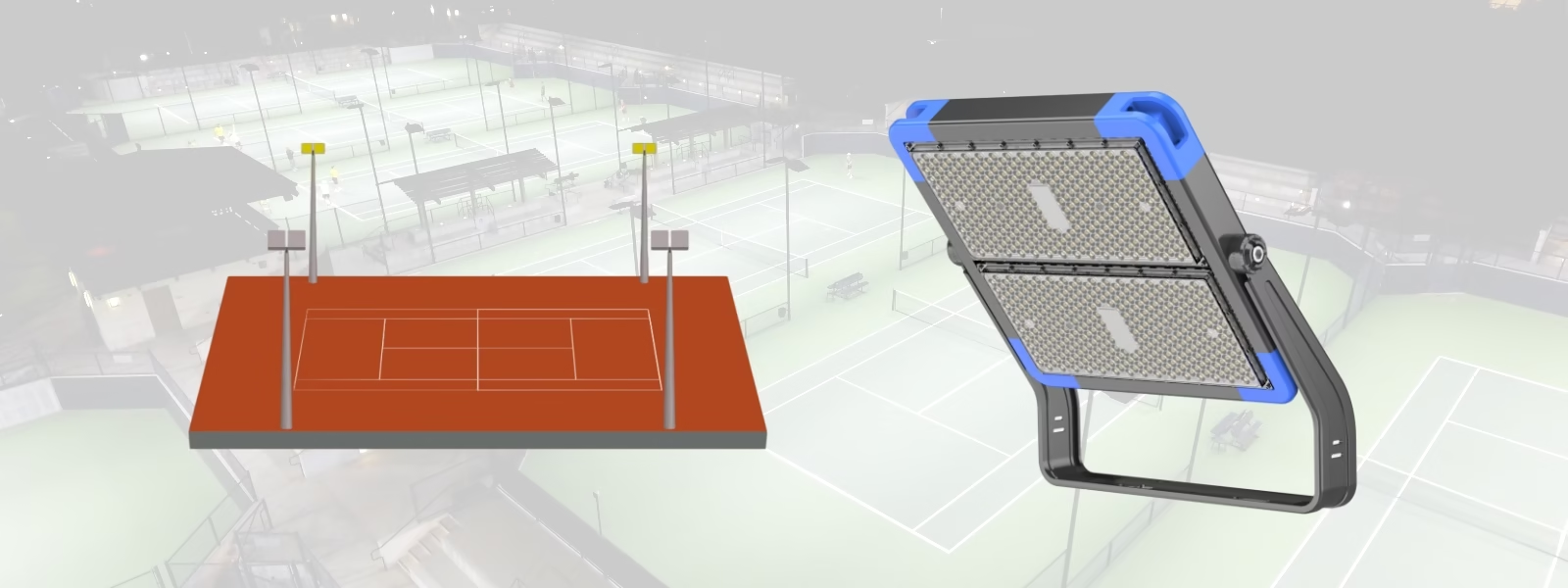
Tennis court lighting directly affects player visibility, match quality, safety, and overall facility performance. Whether the project is a private court, tennis club, sports complex, school, or tournament venue, the lighting system must provide sufficient illumination, excellent uniformity, and effective glare control while complying with recognized sports lighting standards.
A successful tennis court lighting solution is based on the required illuminance level, competition standard, court size, installation method, and lighting performance targets. Proper lighting design improves visibility, enhances the playing experience, and helps ensure long-term operational reliability.
Before selecting fixtures, it is important to understand the standards, lighting requirements, and design considerations that determine overall project performance.
What Are the Standard Dimensions of a Tennis Court?
Lighting design should always begin with the actual playing area rather than the court markings alone.
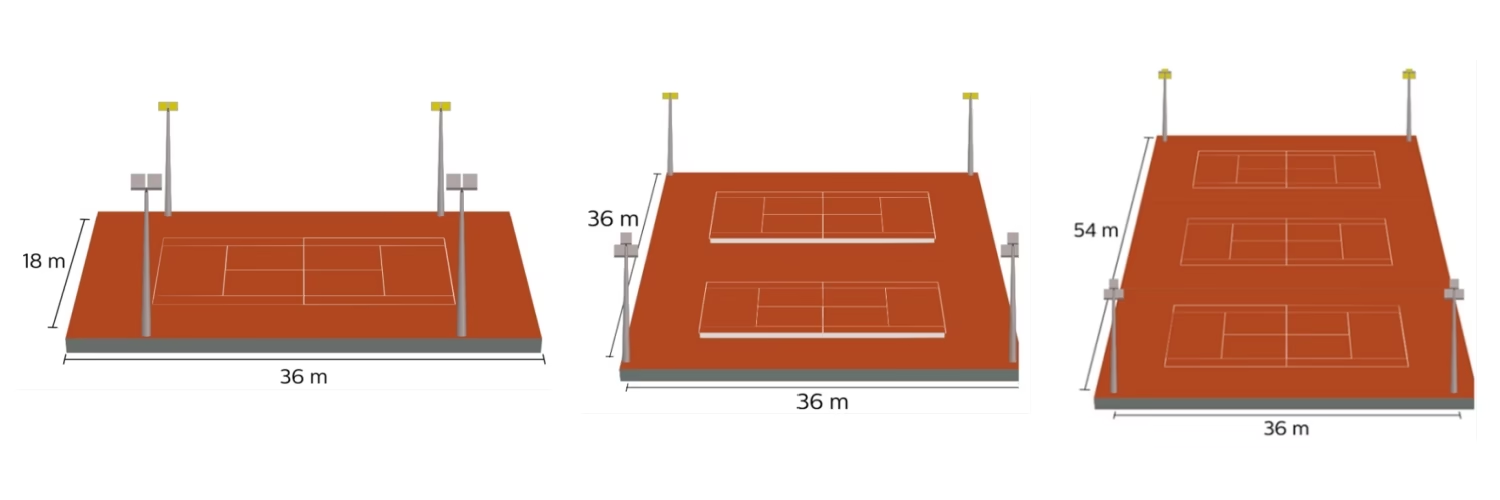
A standard tennis court measures 23.77 m in length. However, lighting calculations should be based on the full playing area, which typically extends to approximately 36 m × 18 m to include player movement and run-off zones.
Singles and Doubles Court Dimensions
| Court Type | Dimension |
|---|---|
| Singles Court | 23.77 × 8.23 m |
| Doubles Court | 23.77 × 10.97 m |
| Net Height (Center) | 0.914 m |
Recommended Design Areas
| Configuration | Typical Design Area |
|---|---|
| Single Court | 36 × 18 m |
| Double Courts | 36–40 × 36 m |
| Triple Courts | 36–40 × 54 m |
| Four Courts | 36–40 × 72 m |
Why Design Area Matters
Many lighting projects focus only on the marked court dimensions. In reality, players frequently move outside the sidelines and baselines during play.
If the lighting design ignores these areas, dark zones can appear around the perimeter, reducing visibility and affecting player comfort.
Professional lighting calculations should always cover the entire playing area rather than only the court markings.
Personal Insight
In my experience, using the complete playing area during the design stage significantly improves lighting uniformity and often eliminates the need for adjustments after installation.
What Lighting Standards Apply to Tennis Court Projects?
Lighting standards establish the minimum requirements for visibility, safety, and playing quality.
EN 12193 is the most widely referenced sports lighting standard for tennis court projects, while ITF facility guidelines provide additional recommendations for competitive tennis environments.
Major Tennis Court Lighting Standards
| Standard | Scope | Purpose |
|---|---|---|
| EN 12193:2018 | Europe and International Projects | Sports lighting performance requirements |
| ITF Facility Guidelines | International Tennis Facilities | Competition and venue requirements |
EN 12193 Tennis Court Lighting Classes
| Class | Application | Average Illuminance | Uniformity U0 |
|---|---|---|---|
| Class III | Training & Recreational Play | 200 lux | ≥0.50 |
| Class II | Club Competition | 300 lux | ≥0.70 |
| Class I | National & International Competition | 500 lux | ≥0.70 |
Why Compliance Matters
Compliance helps ensure:
- Adequate player visibility
- Consistent playing conditions
- Reduced glare
- Better spectator experience
- Easier project approval
Personal Insight
Many customers initially focus on fixture wattage. However, successful projects are evaluated by illuminance, uniformity, glare control, and overall lighting quality rather than power consumption alone.
How Does ITF Influence Tennis Court Lighting Design?
The International Tennis Federation plays an important role in defining the requirements for competitive tennis facilities.
While EN 12193 specifies illuminance and uniformity requirements, ITF recommendations focus on player visibility, ball tracking, and overall playing conditions.
Ball Visibility
Tennis players continuously track a small ball moving at high speed. Lighting must support visibility throughout the entire flight path rather than only on the court surface.
Uniform Playing Conditions
Uneven lighting can affect player perception and reaction times. Uniform illumination helps maintain consistent playing conditions across the entire court.
Competition Requirements
Higher-level competitions often require stricter lighting performance, particularly regarding glare control and visual comfort.
Broadcast Considerations
Professional tournaments may require additional lighting performance beyond standard competition requirements to support television and video production.
Personal Insight
When designing competition-level facilities, I often find that player comfort and visibility have a greater impact on overall satisfaction than simply increasing lux levels.
What Lux Level Is Required for Tennis Court Lighting?
The required illuminance level depends on the level of play and the intended use of the facility.
Most recreational courts require approximately 200 lux, club competition courts require around 300 lux, and national or international competition courts typically require at least 500 lux according to EN 12193.
Recommended Illuminance Levels
| Application | Average Illuminance |
|---|---|
| Recreational Tennis | 200 lux |
| Club Competition | 300 lux |
| National Competition | 500 lux |
| Professional Tournament | 500–1000 lux |
| Broadcast Venue | 1000–2000+ lux |
Horizontal Illuminance
Horizontal illuminance measures the amount of light reaching the court surface and is the primary metric used in sports lighting calculations.
Vertical Illuminance
Vertical illuminance measures the amount of light reaching players and the tennis ball. This becomes increasingly important at higher levels of play.
Why More Lux Is Not Always Better
Higher illuminance levels increase energy consumption and may create additional glare if not carefully controlled.
Lighting quality should always be considered together with illuminance levels.
Personal Insight
When discussing projects with customers, I typically recommend determining the competition level first. Once the target standard is defined, the appropriate illuminance level becomes much easier to establish.
What Are Typical Broadcast Lighting Requirements?
Broadcasted tennis matches require higher lighting levels than standard competition play.
For televised matches, vertical illuminance is often more important than horizontal illuminance because cameras must capture players and the ball from multiple viewing angles.
Typical Broadcast Lighting Levels
| Event Level | Typical Vertical Illuminance |
|---|---|
| Regional Broadcast | 1000 lux |
| National Broadcast | 1500 lux |
| International Broadcast | 2000 lux+ |
Why Broadcast Lighting Is Different
Broadcast systems require:
- Higher vertical illuminance
- Better color consistency
- Reduced glare
- Improved image quality
Personal Insight
I have worked on projects where lighting met competition requirements but still required upgrades for broadcasting because camera systems have different visual requirements than players.
Why Are Uniformity and Glare Control Important?
Brightness alone does not guarantee good lighting performance.
Uniformity and glare control are critical for maintaining clear visibility, reducing visual fatigue, and ensuring a comfortable playing environment.
Recommended Uniformity Values
| Application | Uniformity U0 |
|---|---|
| Recreational | ≥0.50 |
| Club Competition | ≥0.70 |
| Tournament | ≥0.70 |
Recommended Glare Ratings
| Application | GR |
|---|---|
| Recreational | ≤55 |
| Competition | ≤50 |
| Professional | ≤45 |
How Glare Affects Performance
Excessive glare can make it difficult to:
- Track high balls
- Receive serves
- Judge ball speed
- Maintain concentration
How Modern LED Lighting Reduces Glare
Modern sports lighting systems typically use:
- Precision optics
- Controlled light distribution
- Anti-glare accessories
- Optimized fixture aiming
Personal Insight
In many projects, improving optical control delivers greater performance improvements than simply increasing illuminance levels.
What Pole Height Is Best for Tennis Court Lighting?
Mounting height has a direct impact on lighting performance.
Most tennis courts use installation heights between 6 m and 12 m, while professional venues and broadcast facilities may require mounting heights of up to 18 m.
Recommended Installation Heights
| Application | Height |
|---|---|
| Residential Court | 6–8 m |
| Club Court | 8–10 m |
| Competition Court | 10–12 m |
| Broadcast Venue | 12–18 m |
Benefits of Higher Mounting Heights
- Better uniformity
- Wider coverage
- Improved vertical illuminance
- Reduced glare
Potential Limitations
- Higher installation costs
- Increased structural requirements
- More complex foundations
Personal Insight
For most commercial tennis courts, mounting heights between 8 m and 10 m provide an excellent balance between performance and project cost.
Real Tennis Court Lighting Solutions and Project Examples
Click the image to learn more about the product.
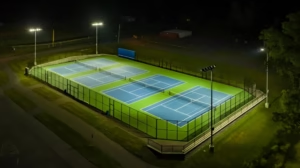
Real project data provides valuable insight into how a tennis court lighting solution performs under actual site conditions.
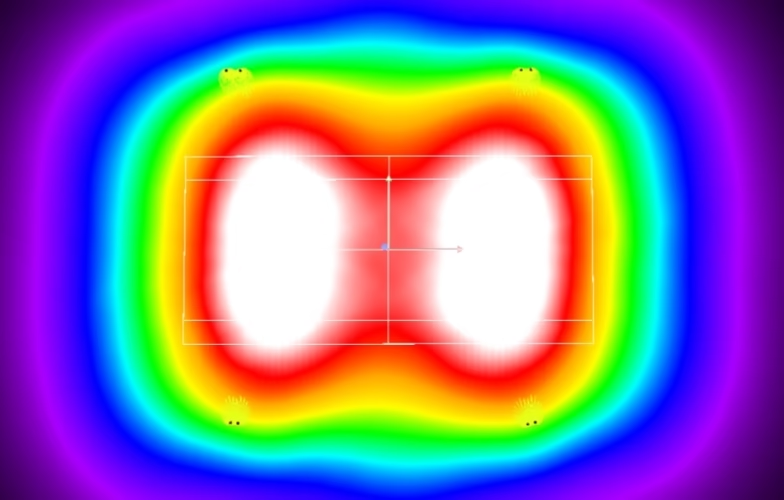
Single Tennis Court Lighting Solution – Class I Competition Standard
Project Overview
| Item | Value |
|---|---|
| Court Type | Single Tennis Court |
| Lighting Standard | EN 12193 |
| Lighting Class | Class I |
| Installation Height | 8m |
| Pole Quantity | 4pcs |
| Fixture Quantity | 8pcs |
| Fixture Power | 500W |
| Average Illuminance (Eav) | 614 lx |
| Uniformity (Emin/Eav) | 0.78 |
Single Tennis Court Lighting Solution – Class II Club Competition Standard
Project Overview
| Item | Value |
|---|---|
| Court Type | Single Tennis Court |
| Lighting Standard | EN 12193 |
| Lighting Class | Class II |
| Installation Height | 8m |
| Pole Quantity | 4pcs |
| Fixture Quantity | 8pcs |
| Fixture Power | 250W |
| Average Illuminance (Eav) | 311 lx |
| Uniformity (Emin/Eav) | 0.81 |
Double Tennis Court Lighting Solution – Class I Competition Standard
Project Overview
| Item | Value |
|---|---|
| Court Type | Double Tennis Court |
| Lighting Standard | EN 12193 |
| Lighting Class | Class I |
| Installation Height | 10m |
| Pole Quantity | 4pcs |
| Fixture Quantity | 8pcs |
| Fixture Power | 1000W |
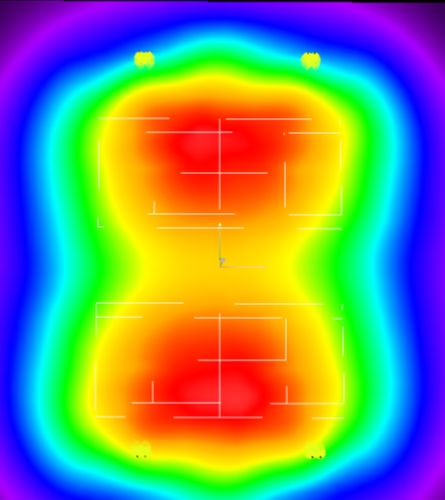
| Average Illuminance (Eav) | 527 lx |
| Uniformity (Emin/Eav) | 0.75 |
Double Tennis Court Lighting Solution – Class II Club Competition Standard
Project Overview
| Item | Value |
|---|---|
| Court Type | Double Tennis Court |
| Lighting Standard | EN 12193 |
| Lighting Class | Class II |
| Installation Height | 10m |
| Pole Quantity | 4pcs |
| Fixture Quantity | 8pcs |
| Fixture Power | 500W |
| Average Illuminance (Eav) | 307 lx |
| Uniformity (Emin/Eav) | 0.75 |
Personal Insight
In my experience, photometric results, installation conditions, and long-term operating performance provide far more value than fixture specifications alone. Reviewing actual project data helps owners, contractors, and consultants evaluate whether a solution is suitable for their specific requirements.
Conclusion
A successful tennis court lighting solution depends on much more than selecting a fixture. Court dimensions, lighting standards, illuminance levels, uniformity, glare control, installation height, and project requirements all play important roles in achieving the desired performance. By designing the lighting system around the specific needs of the facility, owners and contractors can improve visibility, support player performance, and create a high-quality tennis environment that meets both current and future requirements.